

When the Declaration of Independence promised life, liberty, and the pursuit of happiness, ownership was already the currency of that promise. Land was liberty. A home is the foundation upon which families built security, passed down wealth, and claimed their stake in the nation. Two hundred and fifty years later, we must ask an uncomfortable question: Was that promise ever extended to Black Americans?
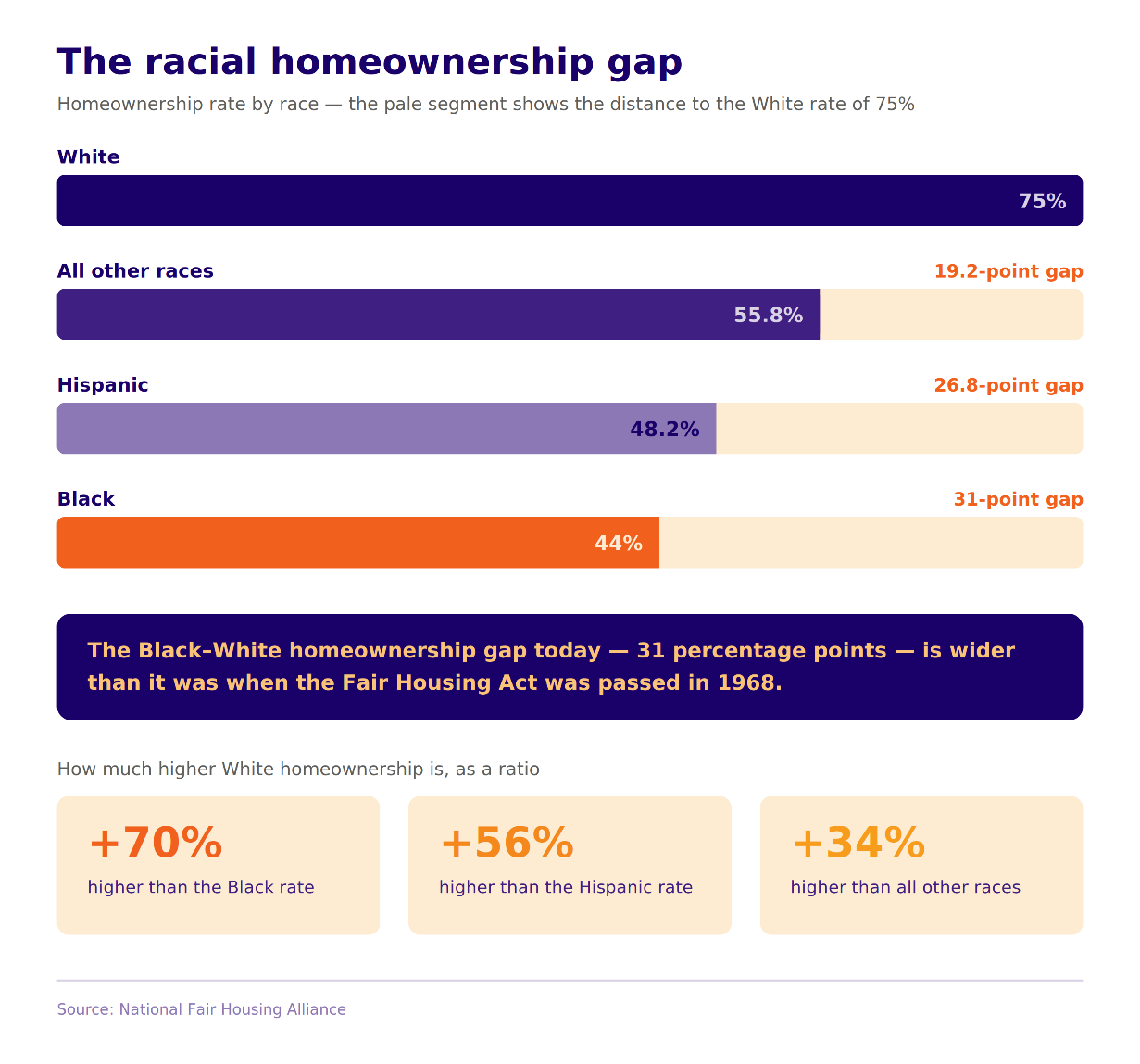
The numbers answer plainly. The Black homeownership rate of 44 percent is only slightly above where it stood when the Fair Housing Act was passed in 1968. The White homeownership rate stands at 75 percent, meaning the Black–White homeownership difference is now 31 percentage points—wider than it was when the law was passed. The homeownership rate for Hispanics in the U.S. is 48.2 percent, creating a 26.8 percentage point difference between Hispanic and White homeowners. White homeownership is 70 percent higher than Black homeownership, 56 percent higher than Hispanic homeownership, and 34 percent higher than the rate for all other races.[i] That is not an accident. It is not the result of individual choices. It is the result of centuries of discrimination in lending, appraisal, and housing policies and practices as well as systems of inequality established by race-based, race-conscious policies enacted by all levels of government and enforced by private actors throughout the housing ecosystem.
America’s Exclusionary Housing and Lending Policies and Practices Still Perpetuate Unfair Outcomes
Consider how deliberately this architecture was built. During the colonial era, White settlers immigrating to America were awarded 50 to 100 acres of land for every person in their household, including enslaved people. The Homestead Acts redistributed 270 million acres of land, commandeering it from Native Indian nations and transferring it to primarily to White families. When the Great Depression struck, the federal government created the Homeowners’ Loan Corporation and the Federal Housing Administration (FHA) to rescue and promote homeownership—then wielded these institutions as instruments of discrimination. The FHA's own underwriting manual instructed appraisers to guard against “inharmonious racial groups” and endorsed racially restrictive covenants. During the agency’s first 30 years, fewer than 2 percent of FHA-insured mortgages went to non-White households. While the government lifted White families into the middle class by increasing their homeownership rate from 40 percent to 70 percent, it locked Black families out. These intentional policy choices relegated Blacks to predatory land contracts, subprime schemes, and a fringe financial market designed to strip wealth rather than build it.[ii]
This is what state-sanctioned racism looks like: the deliberate engineering of a system that builds wealth for White families and extracts it from Black families. That dual credit market still exists. Black mortgage applicants are denied at a rate of 27 percent, compared to 16.5 percent for White applicants.[iii] Black borrowers are disproportionately steered toward higher-cost loans even when they qualify for prime, lower-cost credit. Appraisers value homes in White neighborhoods as 2.5 times more valuable than comparable homes in comparable communities of color. Appraisal bias has stripped an estimated $162 billion in wealth from Black homeowners. And now, algorithmic systems trained on this data shaped by decades of discriminatory and exclusionary policies threaten to automate these inequities at unprecedented speed and scale.[iv]
These disparities unfold amid a fair and affordable housing crisis. America needs 5 million affordable housing units. A quarter of homebuyers and half of renters are cost burdened. They spend more than 30 percent of their income on housing[v] which makes saving for a down payment nearly impossible. Black and Latino families are likelier to be cost-burdened and less likely to receive family financial assistance. Because home equity is the cornerstone of wealth building, the homeownership gap drives the racial wealth gap. Black households hold roughly 15 cents in wealth for every dollar held by White households[vi], and absent intervention, it would take the average Black family over 500 years to reach the wealth White families hold today[vii].
Progress is Being Stymied by Unfair and Exclusionary Policies and Practices
And yet the story is not one of inevitability. Between 2019 and 2024, the Black homeownership rate rose from 40.6 percent to a peak of 46.4 percent—the largest gain of any group—because we acted with intention. Special Purpose Credit Programs (SPCPs), first-generation down payment assistance, shared equity models, modernization of the Qualified Mortgage Rule, and the use of positive rental payment and cash-flow data in underwriting proved that when we design systems for inclusion, everyone benefits.
But that progress is being deliberately reversed. Since the National Fair Housing Alliance (NFHA) released its 2025 State of Equitable Homeownership report, homeownership rates for none-White households have declined. This is a result of the Trump Administration's dismantling of Fannie Mae’s and Freddie Mac’s SPCPs and the elimination of their Fair Housing, Fair Lending, and Equitable Housing Finance Plan requirements. Fair housing enforcement funding has been zeroed out, mortgage servicing protections rescinded, and civil rights oversight of AI abandoned. History teaches us exactly what happens when the nation retreats from enforcement: the gap widens, predators return, and another generation is lost. We are watching it happen in real time.
Closing the Homeownership and Wealth Gaps Require Solutions that Match the Scale of the Problem
Closing the Black–White homeownership gap will take remedies that match the scale and intentionality of the harm. Congress must pass the Downpayment Toward Equity Act, investing $100 billion in first-generation homebuyers. Lenders, as well as Fannie Mae, and Freddie Mac must restore and scale SPCPs. The nation must build the affordable units families desperately need and we must stop exclusionary zoning. Regulators must implement inclusive credit scoring and underwriting systems, reform the appraisal system, address the property insurance crisis, and establish a robust civil rights framework for AI so technologies aren’t infused with bias. And the nation must fully fund fair housing enforcement and honor the Fair Housing Act's mandate to proactively combat segregation and expand access to opportunity.
Inequities built through policy decisions can be narrowed through policy choices. The same nation that engineered exclusion can engineer inclusion. Closing these gaps would add trillions to our economy; more importantly, it would finally redeem the nation’s founding promise. At 250, America's choice is stark: continue perpetuating systems built by centuries of racism or dismantle unfair systems and policies and extend to Black families the same support this country has always given White families. The Dream is not dead. It is waiting for us to stop deferring it.
[i] Homeownership rates are calculated using information from the Federal Reserve Bank of St. Louis. Data available at: https://fred.stlouisfed.org/graph/?g=wZHP
[ii] Rice, Lisa. "The Fair Housing Act: A Tool for Expanding Access to Quality Credit." In The Fight for Fair Housing: Causes, Consequences, and Future Implications of the 1968 Federal Fair Housing Act, edited by Gregory D. Squires, 76–111. New York: Routledge, 2018.
[iii] Shanti Abedin, Laurie Benner, Jameel Khan, Lisa Rice, and Maureen Yap, The State of Equitable Homeownership: 2025 Report (Washington, DC: National Fair Housing Alliance, 2025), https://nationalfairhousing.org/wp-content/uploads/2023/04/The-State-of-Equitable-Homeownership-2025-FINAL.pdf.
[iv] Jonathan Rothwell and Andre M. Perry, "How Racial Bias in Appraisals Affects the Devaluation of Homes in Majority-Black Neighborhoods," Brookings Institution, December 5, 2022, https://www.brookings.edu/articles/how-racial-bias-in-appraisals-affects-the-devaluation-of-homes-in-majority-black-neighborhoods/.
[v] Peyton Whitney, "Housing Unaffordability Soared to New Highs in 2024," Housing Perspectives (blog), Joint Center for Housing Studies of Harvard University, February 4, 2026, https://www.jchs.harvard.edu/blog/housing-unaffordability-soared-new-highs-2024.
[vii] Dedrick Asante-Muhammad, Chuck Collins, Omar Ocampo, and Sara Sim, Still a Dream: Over 500 Years to Black Economic Equality (Washington, DC: National Community Reinvestment Coalition and Institute for Policy Studies, 2023), https://ncrc.org/still-a-dream-over-500-years-to-black-economic-equality/.